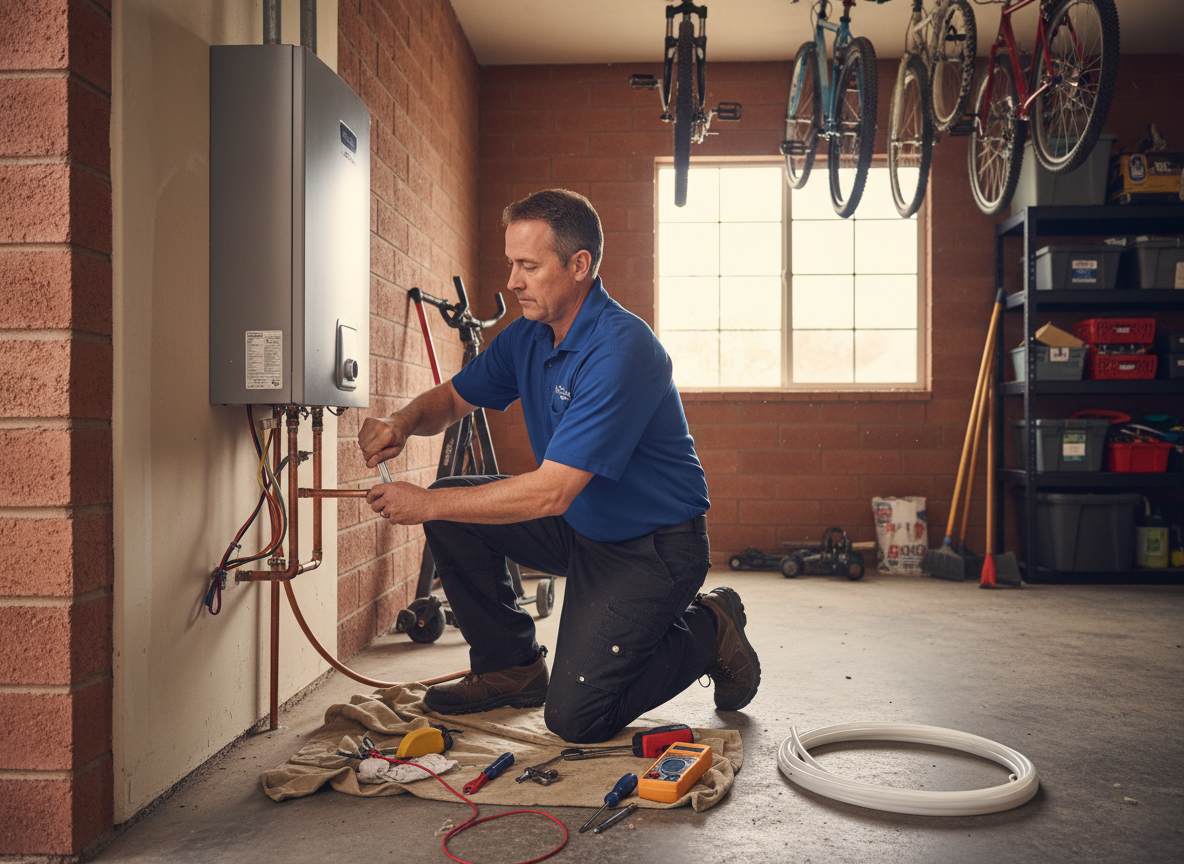
Mesa's hot desert climate drives extreme summer temperatures that force tankless units to work harder, while Maricopa County groundwater carries high mineral content that quickly forms scale inside heat exchangers. Homes in Downtown Mesa and Red Mountain often see flow reduction after just a few years because the compact design of tankless models leaves little room for buildup before performance drops. Technicians familiar with these conditions check the entire venting path and inlet screens first, since dust and scale combine to restrict combustion air during peak heat.
Superstition Springs neighborhoods sit closer to the Superstition Mountains where soil minerals leach into the water supply, accelerating the same problem in both newer builds and older single-family homes. Same-day water heater service becomes essential when a unit fails during monsoon season or a family returns from travel to no hot water. Repair work here focuses on descaling the secondary heat exchanger and replacing the flow sensor before the unit locks out on error codes common to hard-water environments.
Nearby Phoenix and Tempe share the same water chemistry, so parts and service techniques transfer directly, yet Mesa's slightly older housing stock near Riverview Park means more units installed without pre-filters. Emergency water heater repair calls spike when scale breaks loose and clogs the outlet during high-demand evenings. A focused tankless water heater repair addresses the root mineral issue rather than simply resetting the unit, restoring steady temperature across multiple fixtures.
Technician insight
In Mesa, the thing that catches most people out with Tankless Water Heater Repair is how fast scale builds in the compact heat exchanger when no pre-filter is installed. Homes near Superstition Springs and older stock in Downtown Mesa see flow drop sharply once summer demand hits, because the same hard water that affects Phoenix and Tempe moves through smaller passages here.
Red Mountain Residence Flow Loss
A homeowner in Red Mountain reported sudden temperature swings after returning from travel. Inspection showed heavy scale blocking the heat exchanger and a faulty flow sensor. The unit was isolated, descaled on site, and the sensor replaced. Full hot water returned across all fixtures before evening.
Tankless Water Heater Repair Services We Offer
✓Tankless Water Heater Diagnostic Service
Full system check of flow rate, error codes, and heat exchanger condition to identify mineral buildup before it causes shutdown.
✓Hard Water Mineral Buildup Removal
Chemical descaling of the heat exchanger and inlet screen to restore flow in Mesa homes where groundwater leaves heavy scale.
✓Emergency Tankless Water Heater Repair
24/7 response for no-hot-water calls, sensor failures, and lockouts that occur during summer peaks or after travel.
✓Same Day Tankless Water Heater Service
Next-available appointment for flow loss or temperature fluctuation so residents in Red Mountain and Superstition Springs regain hot water the same day.
✓Tankless Flow Sensor Replacement
Swap of the sensor that commonly fails when scale interferes with accurate readings in hard-water areas.
✓Tankless Venting and Air Intake Inspection
Clearing dust and debris from intake and exhaust paths that restrict combustion during Mesa's dusty summer months.
Tankless Water Heater Repair Cost in Mesa, AZ
| Service | Typical Range | What Affects It |
|---|---|---|
| Diagnostic visit | $95–$150 | Applied toward repair when service is performed same day |
| Mineral buildup cleaning | $250–$450 | Depends on severity of scale and unit accessibility |
| Flow sensor replacement | $180–$320 | Includes part and labor for common tankless models |
| Emergency after-hours call | $125–$200 | Added to base service during nights or weekends |
Ranges are typical for Mesa, AZ and confirmed with an exact written quote before any work starts.
How it works
- 1
Initial Assessment
Technician arrives and reviews error codes while measuring inlet and outlet temperatures and flow rate at multiple fixtures.
- 2
System Isolation
Water and gas are shut off, then the unit is flushed to remove loose scale before any internal work begins.
- 3
Component Service
Heat exchanger is descaled, sensors are tested or replaced, and venting is cleared of dust accumulation.
- 4
Performance Verification
Unit is reassembled, powered on, and run through multiple cycles to confirm stable temperature and flow.
- 5
Homeowner Walkthrough
Owner receives explanation of findings and simple steps to slow future scale formation in Mesa water.
Pricing
Upfront quotes provided after diagnostic; no work begins without approval.